Concrete Setting Time: Initial Set, Final Set & What’s Normal
There’s a narrow window between pouring concrete and it becoming too stiff to work with — understanding exactly what setting time means, and what’s normal, helps crews plan a pour instead of racing against it.
What Does ‘Setting’ Actually Mean?
Setting refers to the stiffening of fresh concrete as hydration progresses, transitioning it from a plastic, workable state to a rigid, load-bearing (though still weak) solid. It’s distinct from curing — setting is about the loss of workability and the onset of rigidity, while curing is the much longer process of ongoing strength gain that continues for weeks after the concrete has already set.
Initial Setting Time
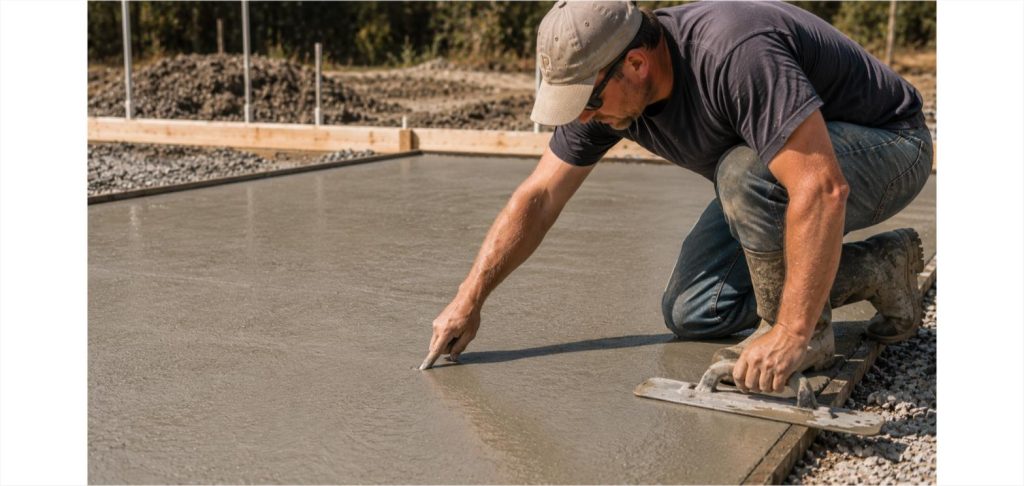
Initial setting time marks the point at which concrete has stiffened enough that it can no longer be reworked, placed, or finished without damaging its developing structure. Practically, this is the deadline for all placement, compaction, and finishing operations — trying to work concrete past this point produces surface tears, poor bonding between layers, and weakened finish quality. For most ordinary Portland cement mixes, initial set typically occurs somewhere between about 30 minutes and a few hours after mixing, heavily influenced by temperature, cement type, and any admixtures used.
Final Setting Time
Final setting time marks the point at which the concrete has fully hardened into a rigid mass, even though it’s still gaining strength for weeks afterward. Beyond this point, the material can generally bear light foot traffic without deforming, though it’s still far from its design strength and needs continued curing and protection. Final set for typical mixes commonly falls somewhere between about 6 and 10 hours after mixing, though this range shifts significantly with temperature and mix design.
Typical Setting Time Ranges
| Stage | Typical Range | Practical Meaning |
|---|---|---|
| Initial Set | 30 minutes – 4 hours | Deadline for placing, compacting, finishing |
| Final Set | 6 – 10 hours | Concrete has hardened; light foot traffic tolerable |
| Walk-on Strength (informal) | ~24 hours (varies) | Surface generally firm enough for careful walking |
| Formwork Removal (typical, non-structural) | 24 – 48 hours (varies by element & code) | Depends on element type, temperature, and local code |
These figures are general guidance, not fixed rules — always confirm setting and formwork removal timing against your project specification, local code, and actual site conditions rather than relying on generic numbers alone.
How Setting Time Is Measured
In a laboratory setting, setting time is measured precisely using a Vicat apparatus with a needle of standard dimensions, tracking the depth of penetration into a cement paste sample over time until it reaches the defined initial and final set criteria. On a job site, setting behavior is usually judged more practically — through slump loss over time, thumb-pressure resistance tests, or simply tracking how the surface responds to finishing tools.
What Affects Setting Time
- Temperature: higher temperatures accelerate hydration and shorten setting time significantly; colder temperatures extend it.
- Cement type: rapid-hardening cements set noticeably faster than ordinary general-purpose cement.
- Water-cement ratio: higher water content can extend workable time slightly but generally weakens the final result.
- Admixtures: retarders extend setting time deliberately (useful in hot weather or large pours); accelerators shorten it (useful in cold weather or fast-turnaround work).
- Humidity and wind: can indirectly affect apparent setting behavior at the surface by changing evaporation rate, distinct from the underlying chemical setting process.
Why Setting Time Matters for Planning a Pour
Setting time directly determines how much working time a crew has to place, compact, level, and finish concrete before it becomes unworkable. Underestimating setting time on a hot day, or overestimating it on a cold one, is a common cause of poor surface finishes, cold joints between sequential pours, and rushed, lower-quality work near the end of a placement. Crews often deliberately request retarding admixtures for large or complex pours specifically to extend this working window safely, without resorting to adding extra water.
Setting Time vs Curing Time: Avoiding the Mix-Up
It’s common to conflate setting time (hours) with curing time (weeks), but they describe very different things. Concrete that has set is hard enough to hold its shape and support light loads, but it is nowhere near its full design strength — that continues to develop over the standard 28-day curing benchmark and beyond, provided the concrete is kept adequately moist during that period.
Common Mistakes Related to Setting Time
- Continuing to finish or trowel concrete after it has passed initial set, damaging the surface.
- Assuming concrete that has set is already at full strength and removing formwork or applying load too early.
- Not adjusting expectations for setting time in hot or cold weather, leading to rushed or delayed work.
- Creating unintended cold joints by not managing the time gap between sequential concrete placements against already-setting concrete.
Related Reading
- Why Temperature Control Matters Before Pouring Concrete
- Concrete Slump Test: What It Is and Why It’s Done
- Concrete Curing Time Guide
- How Cement Is Tested: Standard Cement Quality Tests Explained
Frequently Asked Questions
What is the difference between initial and final setting time?
Initial set marks the end of usable working time for placing and finishing; final set marks the point the concrete has fully hardened into a rigid mass.
How long does concrete take to set?
Typically initial set occurs within 30 minutes to a few hours, and final set within about 6–10 hours, though this varies with temperature and mix design.
Is setting time the same as curing time?
No — setting time is measured in hours and refers to hardening, while curing time refers to the much longer strength-gain process measured in weeks.
Can setting time be extended intentionally?
Yes, using retarding admixtures, commonly for hot-weather pours or large placements needing extra working time.
Does cold weather affect setting time?
Yes — cold temperatures slow hydration and extend setting time significantly compared to normal conditions.
What happens if concrete is finished after initial set?
Working the surface past initial set typically damages the developing structure, producing tears, poor bonding, and a weaker finish.