Cylinder vs Cube Strength Testing: How Concrete Compressive Strength Is Measured
Two different specimen shapes are used around the world to test the exact same property, and they consistently give different numbers for identical concrete. Here’s what’s actually behind that difference.
Why Compressive Strength Testing Exists
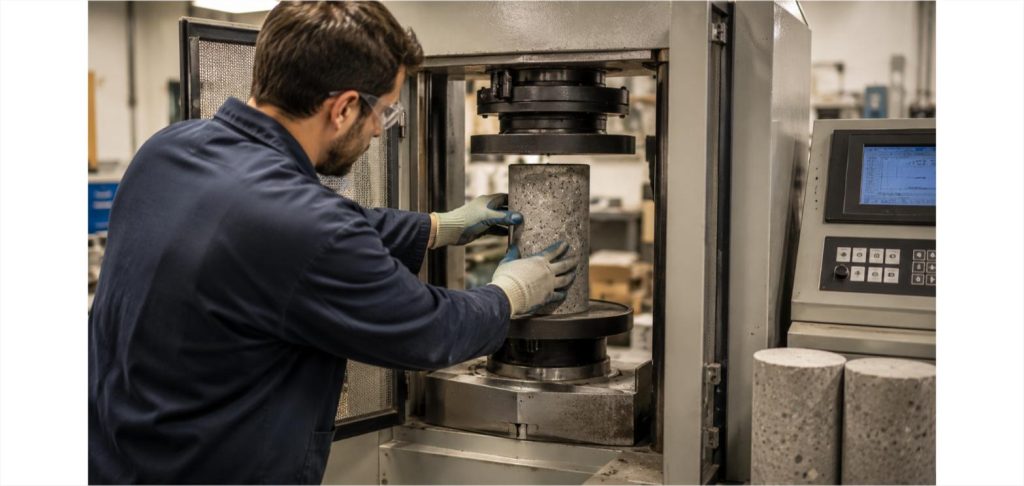
Compressive strength testing is the definitive, end-of-the-line confirmation that a concrete mix reached the design strength it was specified for. Samples are cast from fresh concrete at the point of placement, cured under controlled conditions, and then crushed in a compression testing machine — usually at 7 days as an early indicator and at 28 days as the official benchmark result.
The Cylinder Test
Cylinder testing is the standard method used in the United States and several other countries. A standard specimen measures 150mm in diameter by 300mm in height (or 100mm by 200mm for a smaller variant), giving a height-to-diameter ratio of 2:1. This tall, slender shape is intentional — it creates a more uniform stress distribution through the middle of the specimen during crushing, away from the confining friction effects at the top and bottom platens.
Cylinder Compressive Strength = Crushing Load ÷ Cross-Sectional Area (π × r²)The Cube Test
Cube testing is the standard method in the UK, India, Pakistan, and many other countries following British or Euro-based standards. A standard cube measures 150mm on every side (or 100mm for smaller aggregate mixes). Cubes are simpler and cheaper to cast and handle, but their shorter, stockier proportions mean the confining friction from the testing machine’s platens affects a larger share of the specimen’s total height, which tends to produce a higher recorded strength than an equivalent cylinder.
Cube Compressive Strength = Crushing Load ÷ (Side Length)²Why Cube Results Read Higher Than Cylinder Results
The difference comes down to the height-to-diameter (or height-to-side) ratio, not the concrete itself. In a tall, slender cylinder, the middle section is largely free from the restraining friction the platens create at the top and bottom faces, so it fails more purely under compression. In a stockier cube, that same restraining effect covers a much larger proportion of the specimen, effectively “propping it up” and requiring more load to cause failure. As a widely used rule of thumb:
Cylinder Strength ≈ Cube Strength × 0.8
(or equivalently: Cube Strength ≈ Cylinder Strength × 1.25)
This ratio is an approximation, not an exact conversion — the actual relationship shifts somewhat with mix design, strength level, and curing conditions, so specifications should never be casually converted between systems without appropriate care.
Side-by-Side Comparison
| Property | Cylinder | Cube |
|---|---|---|
| Standard Size | 150mm × 300mm (2:1 ratio) | 150mm × 150mm × 150mm |
| Common Regions | US and similar standards | UK, India, Pakistan, and similar standards |
| Typical Recorded Strength | Lower (more uniform failure) | Higher (platen restraint effect) |
| Casting/Handling | Requires cylindrical molds, slightly more care | Simpler to cast, handle, and cap |
| Approximate Relationship | ≈ 0.8 × Cube Strength | ≈ 1.25 × Cylinder Strength |
How the Test Is Actually Performed
- Sample fresh concrete from the batch being placed, following proper sampling procedure.
- Cast the sample into a cylinder or cube mold in layers, compacting each with a rod or vibration table.
- Cure the specimen — typically in a moist room or water tank at a controlled temperature — for the required period (commonly 7 and 28 days).
- Cap or grind the specimen ends/faces flat and parallel to ensure even load distribution.
- Load the specimen in a calibrated compression testing machine at a standard rate until it fails, and record the maximum load.
Interpreting a Result
A single test result is judged against the specified design strength (with an allowable statistical margin, since concrete strength naturally varies between samples), rather than expecting every single specimen to hit the target exactly. Most specifications require averaging results from multiple specimens from the same batch and comparing that average, along with individual results, against acceptance criteria defined in the project specification or applicable standard.
Common Mistakes in Strength Testing
- Comparing a cylinder result directly against a cube-based specification without applying an appropriate conversion.
- Poor specimen curing (drying out, incorrect temperature) that produces artificially low results unrelated to actual mix quality.
- Uneven or unfinished specimen end/cap surfaces, causing stress concentrations that lower the recorded strength.
- Testing at the wrong loading rate, which can meaningfully skew the recorded failure load.
Related Reading
- Concrete Grade & PSI Strength Guide
- Concrete Material Testing: An Overview of Quality Control
- Concrete Setting Time: Initial Set, Final Set & What’s Normal
- Cement, Sand & Aggregate Ratio Guide by Concrete Strength
Frequently Asked Questions
Why do cube tests give higher strength than cylinder tests?
Because the shorter, stockier cube shape keeps a larger proportion of the specimen influenced by friction from the testing machine’s platens, which raises the recorded failure load compared to a slender cylinder.
What is the approximate conversion between cube and cylinder strength?
A common approximation is cylinder strength ≈ 0.8 × cube strength, though this ratio can shift with mix design and strength level.
Which countries use cylinders vs cubes?
Cylinders are standard in the US and similar systems, while cubes are standard in the UK, India, Pakistan, and many countries following British or Euro-based standards.
When is concrete strength usually tested?
Most commonly at 7 days as an early indicator and at 28 days as the official benchmark result.
Can a single failed test mean the concrete is bad?
Not necessarily — specifications typically use averages across multiple specimens and allow for statistical variation before drawing that conclusion.
Does curing affect the test result?
Yes significantly — poorly cured specimens can show artificially low strength unrelated to the actual quality of the concrete placed.