Concrete Slump Test: What It Is and Why It’s Done
The slump test is the fastest quality check performed on almost every concrete delivery. It doesn’t measure strength directly, but it tells you within two minutes whether the batch in front of you matches what was ordered.
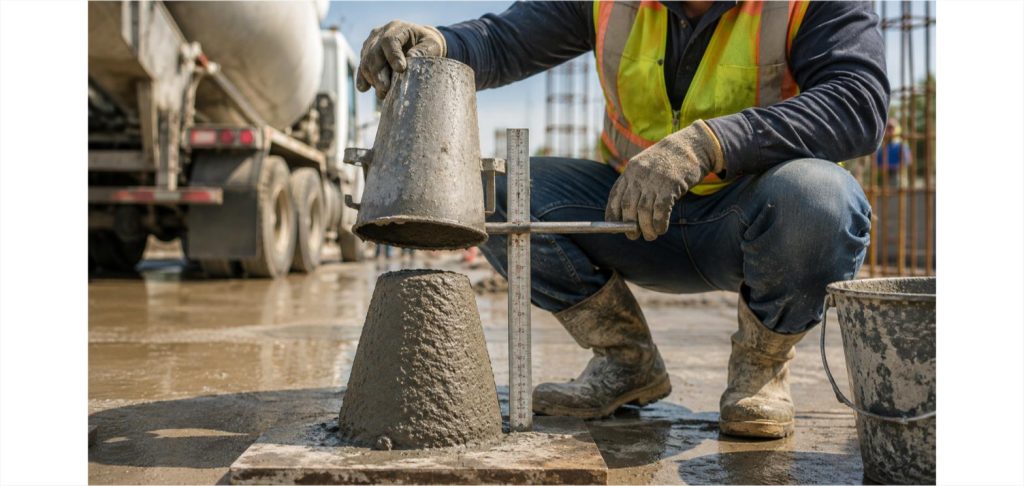
What Is the Slump Test?
The slump test measures the consistency (workability) of fresh, unset concrete by observing how much a sample settles, or “slumps,” after being packed into a standard cone-shaped mold and then having the mold lifted away. It is one of the simplest and most widely performed field tests in concrete construction, requiring only a slump cone, a tamping rod, a flat base plate, and a ruler.
Why the Slump Test Matters
Workability directly affects how easily concrete can be placed, compacted, and finished — but it also has a strong relationship with the water content of the mix. Too much water increases slump and makes concrete easier to pour, but weakens the cured result. Too little water makes concrete stiff and hard to compact, risking voids and honeycombing. The slump test gives an immediate, on-site signal of whether the batch’s water content (and therefore its likely strength) matches the design mix, without waiting weeks for a compressive strength result.
- Confirms the batch matches the ordered mix design before it’s placed.
- Flags over-watered (“cut”) loads that would compromise strength.
- Helps maintain consistency between multiple truckloads on a large pour.
- Provides a quick pass/fail check that doesn’t require lab equipment.
How the Slump Test Is Performed
- Dampen the slump cone and base plate, and place the cone on a level, rigid, non-absorbent surface.
- Fill the cone in three roughly equal layers, tamping each layer 25 times with a standard rod.
- Strike off excess concrete level with the top of the cone once the third layer is compacted.
- Lift the cone straight upward in one smooth motion over about 5–10 seconds, without twisting.
- Immediately measure the vertical difference between the top of the cone and the highest point of the slumped concrete.
Slump = Height of Cone − Height of Slumped ConcreteInterpreting the Result
| Slump Range | Consistency | Typical Use |
|---|---|---|
| 0–25mm | Very stiff / low workability | Pavements, mass concrete, low-slump structural work |
| 25–75mm | Stiff | Reinforced foundations, some slabs |
| 75–125mm | Medium | Most reinforced slabs, beams, columns |
| 125–180mm+ | High / flowing | Pumped concrete, congested reinforcement, self-leveling applications |
Most standard residential slabs specify a target slump somewhere around 75–125mm, with an allowable tolerance (commonly ±25mm) depending on the local specification and delivery ticket.
Types of Slump Failure
Not every sample gives a clean, even slump. True slump is the standard even settling described above. Shear slump occurs when one side of the sample slides or shears away, usually indicating a harsh or poorly cohesive mix — this result is generally considered invalid and the test should be repeated with a fresh sample. Collapse slump happens when the sample essentially flattens out completely, typically pointing to a very wet, high-slump mix, sometimes intentionally designed that way for pumped or flowing concrete.
What a Low or High Slump Tells You
A slump lower than specified usually means the batch has less water (or has already begun losing workability due to time, heat, or evaporation) than intended — while this could mean higher strength, it can also mean the load is difficult to place and compact properly. A slump higher than specified almost always signals extra water was added, either at the plant or on site, which directly threatens the design strength of the pour, even though the concrete looks easier to work with.
Slump vs Strength: A Common Misconception
Many crews mistakenly treat a high slump as a sign of “good” concrete because it’s easier to place and finish. In reality, slump measures workability, not strength — and for a fixed cement content, higher slump achieved by adding water almost always means lower final strength. If a mix needs to be more workable without sacrificing strength, the correct fix is a water-reducing admixture, not extra water.
Slump Testing Frequency on a Job Site
Best practice is to test slump on the first load of every pour, whenever the appearance of the concrete changes noticeably between trucks, and periodically throughout a large pour to catch drift in batching consistency. Any load outside the specified slump range should be evaluated before placing — accepting it, adjusting it with an approved admixture at the plant, or rejecting the load, depending on local specifications and the engineer’s guidance.
Common Mistakes During Slump Testing
- Testing on an uneven or absorbent surface, which skews the result.
- Twisting or jerking the cone while lifting instead of a smooth vertical pull.
- Under- or over-tamping each layer, changing the compaction and therefore the reading.
- Waiting too long after sampling before running the test, allowing the mix to stiffen naturally.
- Accepting a shear-slump result as valid instead of repeating the test with a fresh sample.
Related Reading
- Why Temperature Control Matters Before Pouring Concrete
- Concrete Setting Time: Initial Set, Final Set & What’s Normal
- Cement, Sand & Aggregate Ratio Guide by Concrete Strength
- Concrete Material Testing: An Overview of Quality Control
Frequently Asked Questions
What does a slump test measure?
It measures the workability/consistency of fresh concrete by observing how much a sample settles after a standard cone mold is lifted away.
What is a normal slump for a house slab?
Most residential slabs target roughly 75–125mm, though this varies by specification and placement method.
Does high slump mean weak concrete?
Not necessarily by itself, but if the high slump was achieved by adding extra water beyond the design mix, it usually does mean reduced strength.
What is shear slump?
A failure mode where part of the sample slides away unevenly, usually indicating a harsh mix — the test should be repeated with a fresh sample.
How often should slump be tested?
On the first load of a pour, whenever concrete appearance changes noticeably, and periodically through large pours.
Can slump be adjusted without adding water?
Yes — water-reducing admixtures can improve workability without increasing the water-cement ratio or reducing strength.