How Long Does Concrete Take to Cure? A Curing Time Guide
Concrete strength develops gradually over weeks, not days. Here’s what actually happens during curing, how long you should wait before walking, driving, or building on new concrete, and how to help it cure properly.
Curing vs Drying: An Important Distinction
It’s a common misconception that concrete gets hard as it dries out, similar to clay or paint. In reality, concrete hardens through hydration, a chemical reaction between cement and water that continues as long as moisture and favorable temperature are present. This is why curing — keeping concrete moist and at a reasonable temperature during the early strength-gain period — is so important, and why concrete that dries out too quickly often ends up weaker and more prone to surface cracking.
The 24 to 48 Hour Mark: Safe to Walk On
Most concrete is safe to walk on carefully after about 24 to 48 hours, once the surface has hardened enough to resist light foot traffic without leaving marks. This doesn’t mean the concrete has reached significant strength yet — it’s simply firm enough on the surface to handle light use without damage.
The 7-Day Mark: Roughly 70% Strength
By around 7 days, concrete has typically reached approximately 70 percent of its full design strength, assuming normal curing conditions. This is often the point where light vehicle traffic (like a car on a new driveway section) may be acceptable, though it’s still wise to avoid heavy loads, equipment, or anything that concentrates significant weight on a small area.
The 28-Day Mark: Full Design Strength
28 days is the industry-standard benchmark for concrete’s rated design strength — when a mix is specified as ‘4,000 PSI,’ that rating assumes a standard 28-day cure under normal conditions. Concrete does continue to gain some strength beyond 28 days, but the rate of additional gain slows significantly, which is why 28 days is used as the reference point for testing and specification.
Curing Timeframes by Project Type
- Patios and walkways: light foot traffic after 24-48 hours, full use after about 7 days.
- Driveways: avoid vehicle traffic for at least 7 days, ideally longer in cool weather.
- Footings: should cure fully, often 7+ days, before framing loads are applied.
- Steps: avoid regular use for at least 3-5 days to prevent edge damage.
- Structural columns and footings: follow engineer specifications, often requiring the full 28-day cure before applying design loads.
How to Help Concrete Cure Properly
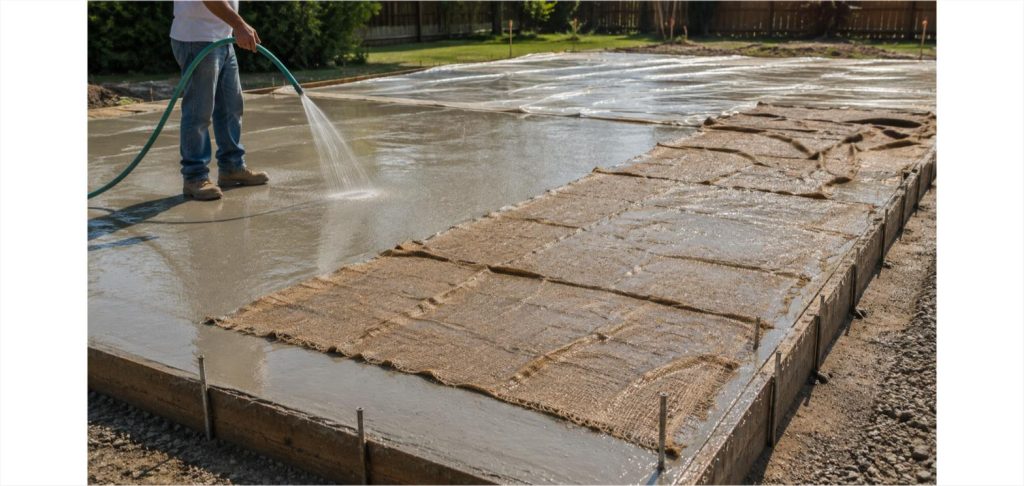
Keep new concrete moist during the first several days by lightly misting it with water, covering it with wet burlap, or applying a curing compound that seals in moisture. In hot, dry, or windy conditions, curing becomes especially important since surface moisture can evaporate faster than the hydration reaction can use it, leading to weak, dusty surfaces or shrinkage cracks. Covering fresh concrete with plastic sheeting is a simple, effective method for retaining moisture in most residential situations.
Cold and Hot Weather Curing
In cold weather, hydration slows down significantly and can stop altogether if concrete freezes before gaining sufficient strength, so pours in near-freezing conditions often need insulating blankets or heated enclosures. In hot weather, the opposite problem occurs — the surface can dry out and begin shrinking before the interior has cured properly, so shading fresh concrete and applying curing compound or wet coverings promptly after finishing helps prevent cracking.
Signs Concrete Wasn’t Cured Properly
Concrete that wasn’t cured properly may show fine surface cracking (crazing), a dusty or chalky surface finish, or lower-than-expected strength when tested. If you notice these signs on a recent pour, there generally isn’t a way to reverse the damage after the fact — proper curing needs to happen during the critical early window, which is why planning your curing method before the pour, not after, is so important.
Plan Your Project’s Timeline
Whether you’re pouring a patio slab, a set of steps, or a footing, build curing time into your project schedule from the start. Rushing to use new concrete before it’s properly cured is one of the most common causes of early cracking, surface damage, and reduced long-term durability.