Concrete Material Testing: An Overview of Quality Control
Concrete quality isn’t confirmed by a single test — it’s the result of checks performed before mixing, during placement, and long after the pour is finished. Here’s the full picture of how quality control actually works.
Why Testing Happens at Multiple Stages
Concrete’s final quality depends on decisions made hours, days, and weeks apart — the cement and aggregate delivered to the batching plant, the water added at mixing, the workability at the point of placement, and the strength gained over the following weeks of curing. Because errors at any one of these stages can silently ruin an otherwise well-designed mix, quality control is built around testing at each stage rather than relying on a single strength result at the very end.
Stage 1: Raw Material Testing (Before Mixing)
Before a single batch is mixed, the raw materials themselves are checked against relevant standards. Cement is tested for fineness, setting time, and soundness. Sand and coarse aggregate are tested for grading, silt/clay content, and moisture. Mixing water is checked to ensure it’s free of harmful levels of chlorides, sulfates, or organic contamination that could interfere with hydration or attack reinforcement over time. These tests catch problems while they’re still cheap and easy to fix — rejecting a bad batch of cement is far less costly than discovering a strength failure weeks after a pour.
Stage 2: Fresh Concrete Testing (At the Point of Placement)
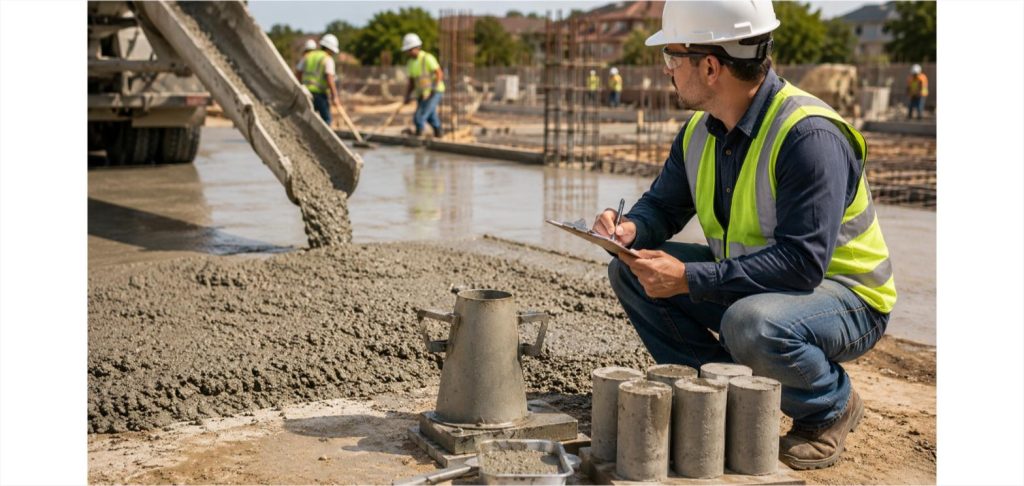
Once batched, fresh concrete is tested to confirm it matches its design mix before it’s placed and becomes impossible to adjust. This includes the slump test for workability, a temperature check to confirm the mix is within a safe placement range, and on larger or specialty projects, an air content test (especially important for concrete exposed to freeze-thaw cycling). Sampling for later hardened-concrete tests also happens at this stage — test cylinders or cubes are cast from the same batch that’s being placed.
- Slump test: checks workability and indirectly flags incorrect water content.
- Temperature test: confirms the mix is within a safe range for proper hydration.
- Air content test: verifies entrained air levels for freeze-thaw durability where specified.
- Sampling: casting cylinders or cubes that will later be crushed to verify strength.
Stage 3: Hardened Concrete Testing (After Curing)
The most well-known test — compressive strength testing of cylinders or cubes — happens well after placement, typically at 7 and 28 days, once the samples have cured under controlled conditions. This confirms whether the concrete actually reached its designed strength grade, closing the loop on everything that happened at the earlier stages. On existing structures, core samples can be drilled and tested, or non-destructive methods like rebound hammer or ultrasonic pulse velocity testing can estimate strength without damaging the structure.
Who Performs These Tests
On larger commercial and infrastructure projects, an independent testing laboratory or the project’s quality control team typically performs sampling and testing according to a formal test plan defined in the project specification. On smaller residential jobs, slump and visual checks are often the extent of on-site testing, with cylinder/cube strength testing reserved for structural elements like footings, columns, or engineered slabs where a permit or inspection requires documented strength verification.
Sampling Frequency Guidelines
| Pour Size | Typical Sampling Frequency |
|---|---|
| Small residential pour (under ~50m³) | One set of test cylinders/cubes, often optional unless required by code |
| Standard commercial pour | One set per truckload or per specified volume interval (e.g., every 50–100m³) |
| Large structural/infrastructure pour | Continuous sampling per project specification, often multiple sets per pour |
Interpreting Results Across Stages
No single test stands alone — a slump result outside spec might explain a later low-strength result, and consistently correct raw-material tests build confidence that any strength issue traces back to placement, curing, or testing error rather than material quality. This is why documentation and traceability (batch tickets, sample labels, curing logs) matter as much as the individual test procedures themselves.
Common Mistakes in Material Testing Programs
- Testing only at one stage (usually final strength) and missing earlier warning signs.
- Inconsistent sampling — testing convenient loads instead of representative ones throughout a pour.
- Poor sample curing or storage, which distorts hardened concrete results independent of the actual mix quality.
- Failing to document test results in a way that allows tracing a problem back to its actual stage of origin.
Related Reading
- How Cement Is Tested: Standard Cement Quality Tests Explained
- Sand Testing for Concrete: Methods, Standards & Why It Matters
- Cylinder vs Cube Strength Testing Explained
- Concrete Slump Test: What It Is and Why It’s Done
Frequently Asked Questions
When is concrete tested during a project?
At three main stages: raw material testing before mixing, fresh concrete testing at placement, and hardened concrete strength testing after curing.
What is the most important concrete test?
No single test is sufficient alone, but compressive strength testing of cylinders/cubes is the final confirmation that a mix reached its design strength.
Do residential projects need full material testing?
Usually not to the same extent as commercial projects — slump and visual checks are common, with strength testing reserved for structural elements when required by code.
What happens if a strength test fails?
It typically triggers further investigation, including checking earlier-stage records, testing additional samples or cores, and possibly engineering evaluation of the affected element.
Who is responsible for concrete testing on a job?
Depending on project size, either an independent testing lab, the contractor’s quality control team, or informally the crew performing basic checks like slump.
Can concrete strength be tested without breaking a sample?
Yes — non-destructive methods like rebound hammer or ultrasonic pulse velocity testing can estimate strength on existing structures.