Aggregate Size Guide: 8mm, 16mm & 20mm Bajri Explained
Bajri isn’t sold in one universal size, and the size you pick changes how your concrete places, finishes, and performs. Here’s what 8mm, 16mm, and 20mm aggregate actually mean on site and how to choose between them.
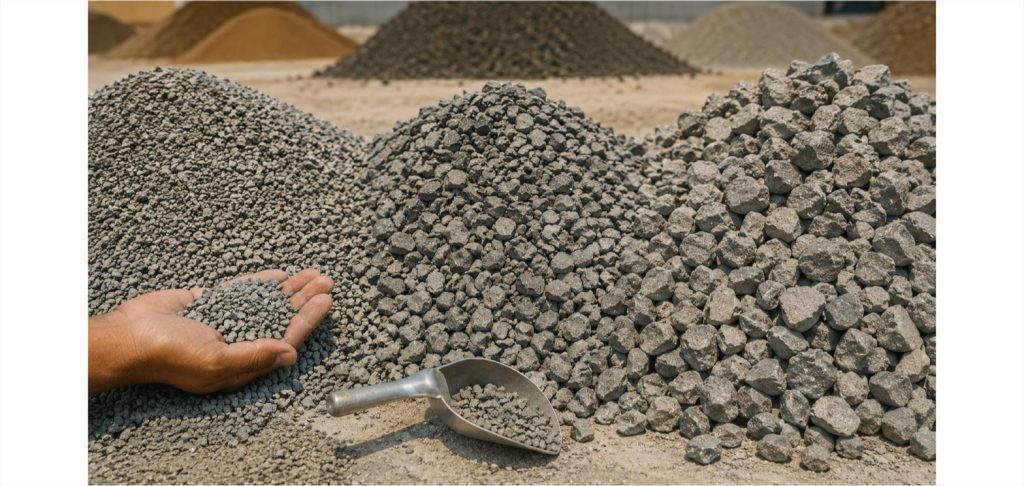
What Is Bajri (Coarse Aggregate) and Why Size Matters
Bajri — crushed stone or gravel used as coarse aggregate — makes up the largest share of concrete’s volume, typically 40–50%. Its job is to act as a stable, low-cost filler around which the cement paste and sand bind everything together. The nominal maximum size of this aggregate (the largest sieve size most of the stone passes through) directly affects how much cement paste is needed, how the mix compacts, and how strong and durable the final concrete is.
Aggregate size is not a matter of preference — it’s matched to the thickness of the section being poured, the density of any reinforcement, and the strength grade required. Using the wrong size can lead to voids, weak spots, or a mix that simply cannot be placed properly around tightly spaced rebar.
Common Aggregate Sizes Used in Concrete Work
- 8mm (3/8 in): A fine coarse aggregate, sometimes called pea gravel or chips, used where sections are thin or reinforcement is dense.
- 16mm (5/8–3/4 in): The most common general-purpose size for residential slabs, footings, and columns.
- 20mm (3/4–1 in): A larger aggregate used in mass concrete, road base, and thicker sections where maximum bulk and lower cement demand matter more than tight clearances.
How Aggregate Size Affects Workability
Smaller aggregate particles have more combined surface area for a given volume, which means the mix needs more cement paste to coat every particle and keep the mixture cohesive. This makes 8mm mixes feel “stickier” and easier to pump or place into tight forms, but also more expensive per cubic meter of concrete since more cement is required. Larger 20mm aggregate needs less paste, is cheaper per unit volume, but is harder to compact into thin slabs or squeeze between closely spaced rebar.
How Aggregate Size Affects Strength & Density
Larger aggregate generally produces slightly higher strength per unit of cement because it reduces the total surface area that needs to be bonded, and it packs more densely, leaving less room for voids. However, this advantage disappears quickly if the aggregate is too large for the section — a 20mm stone crammed into a 75mm thick slab will create weak points and surface defects rather than added strength. In practice, aggregate size and cement content are balanced together, not optimized separately.
Choosing Aggregate Size by Application
| Application | Recommended Size | Why |
|---|---|---|
| Thin toppings & screeds (under 50mm) | 8mm | Larger stone won’t fit within the thin section |
| Slabs-on-grade (100–150mm) | 16mm | Balances workability, cost, and strength for standard slabs |
| Footings & foundations | 16–20mm | Thicker sections tolerate larger aggregate; reduces cement demand |
| Columns with dense rebar cages | 8–16mm | Needs to flow between tightly spaced bars without honeycombing |
| Mass pours, road base, large footings | 20mm | Maximizes bulk fill and minimizes cement cost in large volumes |
As a rule of thumb, the nominal maximum aggregate size should not exceed roughly one-quarter to one-fifth of the section thickness, and it must be able to pass freely between reinforcing bars with adequate clearance.
Aggregate Size vs Cement Paste Requirement
A useful way to think about it: every coarse aggregate particle needs to be fully wrapped in cement paste to bond into the surrounding matrix. Smaller aggregate means more particles, more combined surface area, and therefore more paste — which means more cement (and cost) per cubic meter, all else being equal. This is why fine aggregate mixes, while easier to place in tight spaces, tend to cost more than mixes using larger 20mm stone for the same strength grade.
Grading & Nominal Maximum Size Explained
“16mm aggregate” doesn’t mean every stone is exactly 16mm — it means the aggregate is graded so that essentially all particles pass through a 16mm sieve, with a spread of smaller sizes mixed in down to around 4–5mm. This graded mix of particle sizes is intentional: it allows smaller particles to fill the gaps between larger ones, reducing the total void space that needs to be filled with cement paste. Poorly graded aggregate (too many particles of a single size) increases void space and cement demand.
Worked Example: Comparing Two Slabs
Consider two identical 100mm thick, 10 square meter slabs, one using 16mm aggregate and one using 20mm aggregate, both targeting 4000 PSI.
Slab Volume = 10 m² × 0.10 m = 1.0 m³ (before dry volume conversion)Both slabs need roughly the same total volume of material, but the 16mm mix will typically require slightly more cement to maintain the same strength and workability, while the 20mm mix may compact less evenly at this thickness since the aggregate is close to the one-quarter-of-thickness guideline. For a slab this thin, 16mm is the safer, more consistent choice — 20mm would only make sense if the slab were thicker, such as a 150–200mm footing.
Common Mistakes With Aggregate Size
- Using 20mm aggregate in thin toppings or screeds, causing surface honeycombing and poor finish.
- Ignoring rebar spacing and selecting aggregate too large to flow between bars.
- Assuming a bigger aggregate size is always “stronger” without considering the section thickness.
- Mixing different aggregate sizes inconsistently between batches, causing uneven strength across a pour.
- Not adjusting cement content when switching aggregate size between job sites.
Related Reading
- Cement, Sand & Aggregate Ratio Guide by Concrete Strength
- How to Calculate Concrete Mix Ratio & Material Quantities
- Slab Calculator
- Footing Calculator
Frequently Asked Questions
What size aggregate is best for a house slab?
16mm is the most common all-purpose choice for standard residential slabs between 100–150mm thick.
Can I use 20mm aggregate for a thin topping?
No — 20mm stone is generally too large for sections under about 75–100mm and will create surface defects.
Does smaller aggregate make concrete weaker?
Not inherently, but it typically requires more cement paste to achieve the same strength, which raises material cost.
What does ‘nominal maximum size’ mean?
It refers to the largest sieve size that essentially all the aggregate particles pass through, not a single fixed particle size.
Why does aggregate size matter around rebar?
Aggregate must be small enough to flow between reinforcing bars without getting stuck, or it will create voids called honeycombing.
Is 8mm aggregate more expensive?
Per cubic meter of finished concrete, mixes using smaller aggregate often cost slightly more due to higher cement paste demand.