How Cement Is Tested: Standard Cement Quality Tests Explained
Cement looks like a uniform gray powder, but bags from different batches can behave very differently in a mix. Here’s how labs actually verify cement quality before it ever reaches a mixer.
Why Cement Testing Matters
Cement is the single ingredient most responsible for concrete’s strength and durability, yet it’s manufactured through a complex kiln process where small variations in raw materials, burning temperature, and grinding can shift its properties from batch to batch. Testing cement before use confirms it meets the fineness, setting time, soundness, and strength requirements assumed in the mix design — catching a substandard batch before it’s poured into a structure, not after.
Fineness Test
Fineness measures how finely the cement has been ground, which directly affects how quickly it hydrates and gains early strength — finer cement generally hydrates faster and produces higher early strength. Fineness is checked either by sieve analysis (passing a sample through a standard 90-micron sieve and weighing the residue) or more precisely using a Blaine air permeability apparatus, which estimates the specific surface area of the cement particles.
Fineness (Sieve Method) = (Weight Retained on Sieve ÷ Total Sample Weight) × 100Excessively fine cement can increase water demand and shrinkage, while cement that’s too coarse gains strength too slowly, so standards specify both a maximum residue and, in some cases, a minimum specific surface area.
Consistency Test (Standard Consistency)
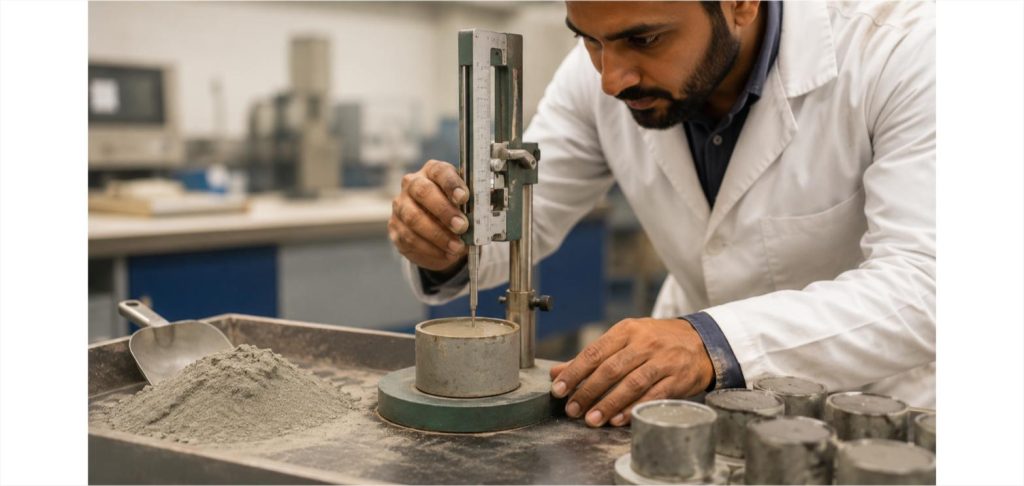
Before setting time or soundness can be tested meaningfully, the amount of water needed to bring a cement paste to a standard reference consistency must first be established using a Vicat apparatus. A plunger of standard dimensions is lowered into a paste sample, and water content is adjusted until the plunger penetrates to a specified depth — this water content becomes the baseline for the setting time tests that follow.
Setting Time Test
Setting time is measured using the same Vicat apparatus, but with a needle instead of a plunger, tracking how the paste stiffens over time.
- Initial setting time: the point at which the needle no longer penetrates to a specified depth — marks the end of usable working time for placing and finishing.
- Final setting time: the point at which the needle leaves only a faint impression on the paste surface — marks the point the cement has effectively hardened.
Most standards require an initial setting time of at least 30 minutes (giving adequate working time) and a final setting time of no more than about 10 hours, though exact limits vary by cement type.
Soundness Test
Soundness refers to whether hardened cement paste retains its volume without excessive expansion, which could otherwise cause cracking long after the concrete has set. The most common method, the Le Chatelier test, uses a small split mold filled with cement paste; after curing in water and then boiling, the amount the mold’s indicator needles spread apart measures expansion. Excessive expansion indicates unsound cement, often caused by free lime or magnesia content that reacts and expands slowly over time.
Compressive Strength Test
Cement itself is strength-tested indirectly, by casting standard mortar cubes (a fixed ratio of cement, standard sand, and water) and crushing them at set intervals, typically 3, 7, and 28 days.
Compressive Strength = Crushing Load ÷ Cross-Sectional Area of CubeThis isolates the cement’s contribution to strength from the variability that aggregate would otherwise introduce, giving a standardized way to compare cement quality between batches, suppliers, or manufacturing plants.
Specific Gravity Test
Specific gravity, typically around 3.1–3.16 for ordinary Portland cement, is measured using a Le Chatelier flask with kerosene (since cement reacts with water). This value is mainly used in mix design calculations to convert between weight and volume of cement accurately, and a value far outside the normal range can also hint at contamination or an unusual cement composition.
Quick Reference: Common Cement Tests
| Test | What It Checks | Typical Apparatus |
|---|---|---|
| Fineness | Particle size / grinding quality | 90-micron sieve or Blaine apparatus |
| Consistency | Baseline water content for further tests | Vicat apparatus (plunger) |
| Setting Time | Working time & hardening onset | Vicat apparatus (needle) |
| Soundness | Volume stability, expansion risk | Le Chatelier apparatus |
| Compressive Strength | Strength contribution of cement | Mortar cubes, compression machine |
| Specific Gravity | Weight-to-volume conversion, purity check | Le Chatelier flask with kerosene |
Field Checks vs Laboratory Tests
On many job sites, a simple field check — verifying the cement is lump-free, feels smooth (not gritty) between the fingers, and has been stored in dry, sealed conditions — is used as a quick sanity check between formal lab tests. Cement that feels gritty or has visible lumps has often absorbed moisture and begun hydrating prematurely inside the bag, and should not be used for structural work even if it hasn’t yet failed a formal test.
Common Mistakes in Cement Testing & Handling
- Using cement straight from long-term storage without checking for lump formation or moisture absorption.
- Skipping the consistency test and estimating water content for setting time tests, which skews the result.
- Comparing strength results from mortar cubes cured under inconsistent temperature or moisture conditions.
- Ignoring soundness testing on a new cement source, risking long-term expansion cracking that won’t show up early.
Related Reading
- Sand Testing for Concrete: Methods, Standards & Why It Matters
- Concrete Material Testing: An Overview of Quality Control
- Cylinder vs Cube Strength Testing Explained
- Cement, Sand & Aggregate Ratio Guide by Concrete Strength
Frequently Asked Questions
Why is cement tested before use?
To confirm it meets fineness, setting time, soundness, and strength requirements, since kiln and grinding variations can change cement properties between batches.
What does the setting time test measure?
How long cement paste takes to stiffen (initial set) and fully harden (final set), using a Vicat needle apparatus.
What is the soundness test for?
It checks whether hardened cement paste stays dimensionally stable, or expands excessively due to free lime or magnesia content.
How is cement strength actually tested?
Indirectly, by casting standard mortar cubes with a fixed cement-sand-water ratio and crushing them at set curing intervals.
What does fineness affect?
How quickly cement hydrates and gains early strength — finer cement generally hydrates faster.
Can I judge cement quality without lab tests?
A basic field check (no lumps, smooth texture, dry storage) is useful, but formal lab testing is needed to confirm quality for structural work.