Why Temperature Control Matters Before Pouring Concrete
Concrete is a chemical reaction, not a drying process, and that reaction is extremely sensitive to temperature. Getting the temperature wrong before a pour can cost strength permanently — here’s why it’s controlled so carefully.
Concrete Hardens Through Chemistry, Not Drying
It’s easy to assume concrete gets hard simply by drying out, but it actually hardens through hydration — a chemical reaction between cement and water that produces heat and forms the crystalline structure responsible for strength. Like most chemical reactions, hydration speeds up in warm conditions and slows down in cold ones, which is exactly why temperature control before and during a pour has such an outsized effect on the final result.
Why Concrete Temperature Is Checked Before Pouring
- To confirm the mix hasn’t already started setting prematurely due to excessive heat gain during transport.
- To predict how much working time (before initial set) the crew will realistically have to place and finish the concrete.
- To decide whether cold-weather or hot-weather precautions (insulating blankets, retarders, ice in the mix, etc.) need to be applied before placement begins.
- To protect against thermal cracking risk in mass pours, where the difference between core and surface temperature can cause internal stress.
What Happens When Concrete Is Poured Too Cold
Hydration slows dramatically below about 5°C (41°F) and can effectively stop if the mix freezes before gaining sufficient strength. Water inside fresh, unhardened concrete expands as it freezes, physically disrupting the developing paste structure and causing permanent strength loss and surface scaling that cannot be corrected later, even once temperatures rise. This is why cold-weather concreting often uses heated water and aggregate, accelerating admixtures, and insulating blankets or enclosures to keep the concrete above a minimum curing temperature during its first critical days.
What Happens When Concrete Is Poured Too Hot
At high temperatures — generally above about 32°C (90°F) — hydration speeds up so much that the concrete can experience flash set, stiffening and losing workability far faster than the crew can place and finish it. Hot weather also accelerates surface moisture evaporation, which can outpace the rate bleed water reaches the surface, leading to plastic shrinkage cracking within hours of placement. Hot-weather precautions typically include cooling mix water or aggregate, working during cooler parts of the day, using retarding admixtures, and applying evaporation retardants or fogging equipment during finishing.
The Ideal Placement Temperature Range
Most specifications target a fresh concrete temperature between roughly 10°C and 27°C (50–80°F) at the point of placement, though acceptable ranges vary by project specification and climate. Concrete delivered outside this range isn’t automatically rejected, but it usually triggers additional precautions or adjustments before placement proceeds.
| Concrete Temperature | Risk | Typical Response |
|---|---|---|
| Below 5°C (41°F) | Hydration stalls, freeze damage risk | Heated materials, insulation, accelerators, delay pour |
| 5–10°C (41–50°F) | Slow strength gain, extended set time | Extra curing time, protection from wind/frost |
| 10–27°C (50–80°F) | Low risk — ideal range | Standard placement and curing practices |
| 27–32°C (80–90°F) | Faster set, higher water demand | Retarders, shade, cooler placement timing |
| Above 32°C (90°F) | Flash set, plastic shrinkage cracking | Cooled materials, evening pours, fogging, retarders |
Ambient Temperature vs Concrete Temperature
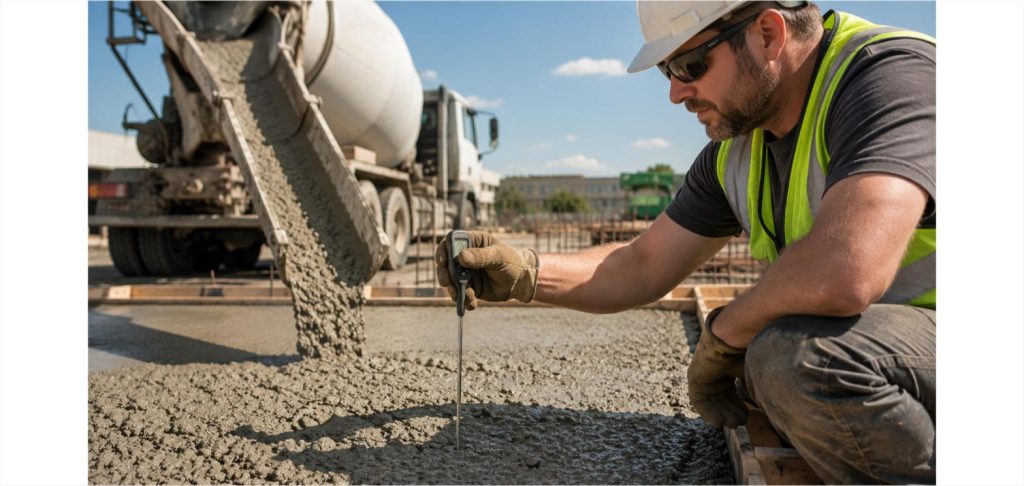
It’s worth distinguishing ambient air temperature from the actual internal temperature of the concrete mix itself, since the two aren’t identical. Concrete generates its own heat through hydration, so on a mild day, a large mass pour can still run significantly hotter internally than the surrounding air. This is measured directly with a concrete thermometer inserted into a sample, not read off a weather forecast.
Subgrade and Formwork Temperature Matter Too
Beyond the concrete itself, the temperature of the subgrade, forms, and any reinforcement the concrete will contact also matters. Pouring warm concrete onto a frozen subgrade, or against cold steel forms, can rapidly chill the concrete at the point of contact, creating uneven curing and a weaker interface layer right where support is needed most. Checking and, if necessary, warming these surfaces before placement is a standard cold-weather practice.
Worked Example: Estimating Working Time
As a rough field guideline, initial set time roughly halves for every 10°C (18°F) rise in concrete temperature above normal conditions, and roughly doubles for a similar drop. A mix that normally sets in about 4 hours at 20°C might realistically set in closer to 2 hours at 30°C, giving the crew significantly less working time to place, compact, and finish the same pour — a key reason crews plan hot-weather pours for early morning or evening.
Common Mistakes With Temperature Management
- Assuming a mild forecast means the concrete itself is at a safe temperature, without measuring it directly.
- Pouring onto a frozen or overheated subgrade without addressing it first.
- Adding extra water in hot weather to compensate for faster stiffening, which weakens the final strength.
- Skipping insulating blankets on a cold-weather pour because daytime temperatures seem acceptable, ignoring an overnight freeze.
Related Reading
- Concrete Setting Time: Initial Set, Final Set & What’s Normal
- Concrete Slump Test: What It Is and Why It’s Done
- Concrete Curing Time Guide
- Concrete Grade & PSI Strength Guide
Frequently Asked Questions
What is the ideal concrete temperature for pouring?
Most specifications target roughly 10–27°C (50–80°F) at the point of placement.
What happens if concrete freezes before it sets?
Ice crystals forming inside the unhardened paste physically disrupt its structure, causing permanent strength loss that cannot be corrected later.
Why does hot weather cause cracking?
High temperatures speed up surface moisture evaporation, which can outpace bleed water reaching the surface, causing plastic shrinkage cracking.
How is concrete temperature measured?
With a concrete thermometer inserted directly into a sample of the fresh mix, not by relying on ambient air temperature.
Does the subgrade temperature matter too?
Yes — pouring onto a frozen or extremely hot subgrade can chill or accelerate the concrete unevenly right at the contact surface.
Can I still pour concrete in cold or hot weather?
Yes, with appropriate precautions like insulating blankets, heated materials, retarders, or adjusted pour timing depending on conditions.