CIRCULAR SLAB CALCULATOR
Circular Slab Calculator
Calculate concrete volume for round patios, fire pit pads, hot tub bases, and circular walkways. Enter diameter and thickness below for instant cubic yard, weight, and bag results.
Quick Answer
A circular slab’s volume equals pi × radius squared × thickness, where radius is half the diameter. Round slabs are common for fire pit pads, hot tub bases, gazebo foundations, and decorative patio sections, and follow the same thickness and reinforcement guidance as rectangular slabs.
Volume (yd³) = π × (Diameter ÷ 2)² × Thickness ÷ 27 × (1 + Waste %)
Try the Calculator
What Is a Circular Slab?
A circular slab is simply a round concrete pour, calculated using the same principles as a rectangular slab but with volume based on radius instead of length and width. Round slabs are a popular choice for fire pit pads, hot tub and spa bases, gazebo and pergola foundations, decorative patio circles, and stepping-stone-style walkway sections. Because a circle has no corners, round slabs are often chosen for their appearance as much as their function, and they pair naturally with curved landscaping, garden beds, or a round structure sitting on top.
Common Uses for Round Slabs
Fire pit pads are one of the most common circular slab projects, typically sized just larger than the fire pit itself to provide a stable, non-combustible base and a small surrounding walking area. Hot tub bases need to be sized to the tub’s footprint plus a service margin, and must be poured thick enough and reinforced adequately to support the substantial weight of a filled tub with occupants. Gazebo and pergola foundations are sometimes a single circular slab or a ring of isolated footings around the perimeter, depending on the structure’s design. Decorative patio circles are often inset into a larger rectangular patio as a focal point, finished with a different texture, color, or scoring pattern to stand out.
How Thick Should a Circular Slab Be?
Thickness recommendations for circular slabs follow the same guidance as rectangular slabs: 4 inches is standard for patios, walkways, and light-duty pads. Hot tub bases, because of the concentrated weight of a filled spa, are usually poured at 4 to 6 inches with reinforcement, and it’s worth checking the tub manufacturer’s specific foundation requirements since some require a specific minimum thickness or reinforcement detail. Fire pit pads can generally use standard 4-inch patio thickness unless the fire pit is unusually large or heavy.
Reinforcement for Round Slabs
Welded wire mesh is the most common reinforcement for circular slabs, and it can be cut and overlapped to fit a round shape without much difficulty. For a hot tub base or any slab carrying concentrated, heavy point loads, consider a rebar grid in addition to or instead of mesh, since the localized weight of tub legs or feet can be significantly higher than a typical foot-traffic patio. As with any slab, reinforcement should be supported on chairs so it stays suspended in the correct position within the concrete rather than resting on the base material.
Forming a Circular Slab
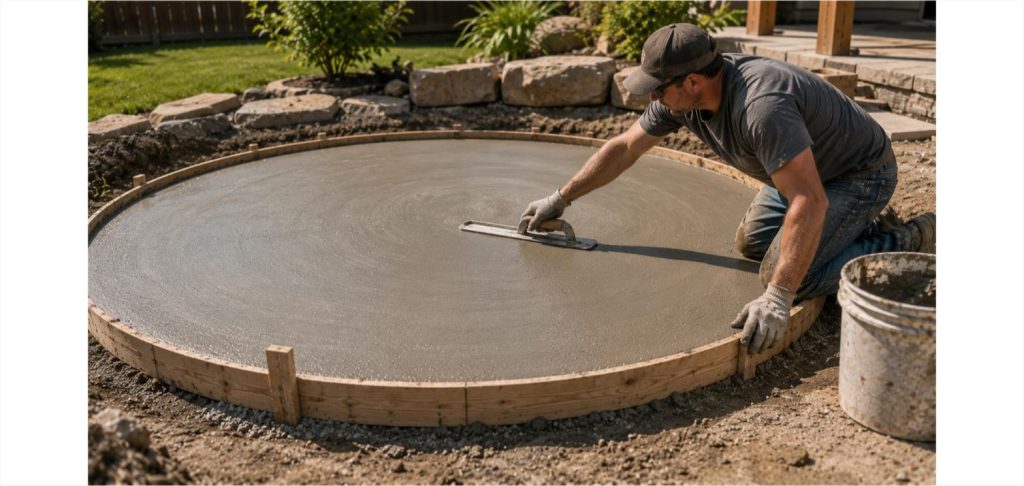
Circular forms can be built from flexible hardboard, plastic edging, or bent plywood strips (sometimes called ‘bender board’), staked into place along the circle’s perimeter. Marking a perfect circle is easiest with a center stake and a string or rigid arm cut to the radius length, which you can rotate around the stake to mark the edge in the ground or in sand before setting forms. For larger circles, some installers segment the form into arcs using multiple shorter, flexible boards rather than one continuous piece, which can be easier to handle and stake securely.
Choosing the Right Concrete Mix (PSI)
Standard patio and walkway PSI guidance applies to circular slabs as well — a 3,000 PSI mix is generally adequate for decorative and light foot-traffic applications. Hot tub bases should use at least 3,500 to 4,000 PSI given the sustained weight involved, and it’s worth confirming the specific PSI recommendation from your hot tub’s installation manual. In freeze-thaw climates, request air-entrained concrete for any circular slab that will be exposed to winter weather.
How to Measure a Circular Slab
Measure the diameter of the circle at its widest point, straight across through the center, along with your planned thickness. If you’re marking the circle yourself, measure the radius (half the diameter) from your center point outward in several directions to confirm it’s consistent before finalizing your forms. The calculator above only needs diameter and thickness — it handles the radius and pi calculations automatically to give you an accurate volume.
Waste Factor for Circular Slabs
Circular slabs often see slightly more waste than rectangular slabs because curved forms are harder to set with total precision, and any small gaps between form segments can let concrete escape during the pour. A waste factor of 10% is a sensible default for round slabs, and larger diameter circles or hand-built segmented forms may benefit from bumping that up to 12 to 15%.
Common Mistakes to Avoid
- Using an inaccurate center point or radius, resulting in an uneven or lopsided circle.
- Under-thickening a hot tub base relative to the manufacturer’s foundation requirements.
- Skipping reinforcement on slabs carrying concentrated point loads like tub feet.
- Not staking flexible forms securely enough, allowing them to bow out during the pour.
- Forgetting a slightly higher waste factor for curved, segmented formwork.
- Ignoring drainage slope, which is just as important on a round slab as a rectangular one.
Tips for a Successful Round Slab Pour
Take the time to get your center point and radius accurate before setting forms, since an uneven circle is very noticeable in a finished patio or pad. Use flexible bender board or hardboard for smooth, consistent curves rather than trying to force rigid lumber into a curve. Check hot tub or spa manufacturer specifications closely before pouring a base, since getting the thickness or reinforcement wrong can void a warranty or create a safety issue once the tub is filled and occupied. As always, order a reasonable waste buffer so you’re not caught short mid-pour.
Related Reading
Frequently Asked Questions
How much concrete do I need for a 10 foot circular slab?
A 10-foot diameter circle at 4 inches thick needs about 0.97 cubic yards before waste. Enter your exact diameter and thickness in the calculator above for a precise figure including bags and weight.
How thick should a hot tub base be?
Most hot tub bases are poured 4 to 6 inches thick with reinforcement, though you should always check your specific tub manufacturer’s foundation requirements.
How do I mark a perfect circle before pouring?
Use a center stake with a string or rigid arm cut to the exact radius length, and rotate it around the stake to mark the circle’s edge before setting your forms.
What forms are used for circular slabs?
Flexible hardboard, plastic landscape edging, or bent plywood strips (bender board) are commonly staked around the perimeter to create a smooth curved form.
Do circular slabs need more waste factor than rectangular ones?
Yes, slightly. Curved forms are harder to seal perfectly, so a 10 to 15% waste factor is a safer default than the 5 to 10% typical for straight-edged slabs.
What size pad do I need for a fire pit?
Size the pad a few feet larger in diameter than the fire pit itself to create a stable base plus a small safety and service margin around the edge.