Material Grading in Concrete: Aggregate & Sand Grading Explained
Grading determines how well different particle sizes pack together inside concrete. Poorly graded material quietly wastes cement and weakens the finished mix — here’s how grading actually works and why it’s checked before every major pour.
What Does ‘Grading’ Mean?
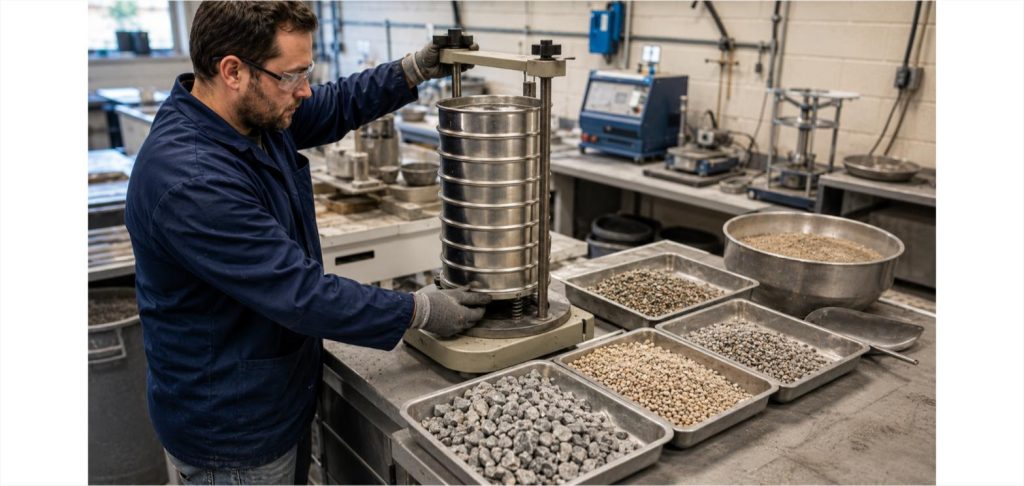
Grading refers to the distribution of particle sizes within a sample of sand or aggregate. It’s determined by passing a sample through a stack of sieves with progressively smaller openings and weighing how much material is retained on each one. The result is a particle size distribution — a picture of how much of the material is fine, medium, or coarse. Grading is not about the average size of particles; it’s about the spread and proportion of sizes present together in the same batch.
Why Grading Matters More Than People Think
Concrete strength and economy both depend heavily on how tightly aggregate particles pack together. A well-graded material has a mix of particle sizes where smaller particles fill the voids between larger ones, minimizing the total empty space that needs to be filled with cement paste. A poorly graded material — for example, aggregate that’s mostly one single size — leaves large voids between particles, which then has to be filled with extra (expensive) cement paste just to hold everything together, without adding proportional strength.
- Well-graded aggregate reduces cement demand for a given strength target.
- It improves workability, making concrete easier to place and finish without segregation.
- It reduces the risk of bleeding and segregation, where heavier particles settle out during placement.
- It produces a denser, less permeable concrete once cured, improving durability.
The Sieve Analysis Test
Sieve analysis (also called gradation testing) is the standard method used to check grading. A dried sample of known weight is passed through a nested stack of sieves, arranged from largest opening on top to smallest at the bottom, and shaken mechanically for a set period. The material retained on each sieve is weighed, and cumulative percentages passing each sieve size are calculated and typically plotted on a grading curve.
Cumulative % Passing = 100 − (Cumulative Weight Retained ÷ Total Sample Weight) × 100The resulting curve is compared against standard grading envelopes (upper and lower limit curves) defined by relevant standards. A material that plots within the envelope is considered well graded for general concrete use.
Fineness Modulus
Fineness Modulus (FM) is a single number summarizing how coarse or fine a graded sample is, calculated by summing the cumulative percentages retained on a standard set of sieves and dividing by 100.
Fineness Modulus = (Sum of Cumulative % Retained on Standard Sieves) ÷ 100A higher FM indicates coarser material, while a lower FM indicates finer material. Concrete sand typically has an FM between about 2.3 and 3.1 — outside this range, the mix may need adjustment to remain workable and economical.
Grading Zones for Sand
Fine aggregate (sand) is commonly classified into grading zones (often Zone I through Zone IV in many standards), based on where its particle size distribution falls relative to standard limits. Zone I sand is coarser overall, while Zone IV is the finest. The zone affects how much cement paste is needed and how the concrete finishes on the surface — finer sand zones generally need slightly more cement to maintain the same water-cement ratio and workability.
Grading of Coarse Aggregate
Coarse aggregate is graded by its nominal maximum size (8mm, 16mm, 20mm, and larger), and within each nominal size, standards specify acceptable percentages passing at intermediate sieve sizes. This is why two suppliers’ “20mm aggregate” can behave differently in the same mix — one may have a tighter, more uniform gradation than the other, even though both are labeled with the same nominal size.
Single-Sized vs Graded Aggregate
Some specialty applications intentionally use single-sized aggregate (nearly all particles close to one size), such as exposed aggregate finishes where a uniform decorative appearance matters more than packing efficiency. For structural concrete, however, graded aggregate is almost always preferred because of its superior packing and reduced cement demand.
Silt, Clay & Deleterious Material
Grading tests are often paired with a check for silt, clay, and organic material content, since these fine contaminants are not part of the intended grading and can weaken the bond between cement paste and aggregate if present in excess. A simple field test — the silt content test using a measuring jar — is commonly used to estimate this before a full lab sieve analysis is run. We cover this specific test in detail in our sand testing guide.
How Grading Problems Show Up On Site
- Excessive bleeding (water rising to the surface) can indicate too much fine material or a gap-graded sand.
- Harsh, unworkable mixes that resist finishing often point to a lack of fine particles filling the voids.
- Segregation during pumping or placing is frequently traced back to a gap in the middle particle sizes.
- Unexpectedly high cement consumption for a given strength target is a common symptom of poor aggregate grading.
Worked Example: Reading a Simplified Sieve Result
Suppose a 1000g sand sample retains 50g on a 4.75mm sieve, 250g on 2.36mm, 300g on 1.18mm, 250g on 600 microns, 100g on 300 microns, and 50g passes the finest sieve.
Cumulative Retained on 2.36mm = 50 + 250 = 300g
% Passing 2.36mm = 100 − (300 ÷ 1000 × 100) = 70%
Repeating this for every sieve builds the full grading curve, which is then compared against the standard envelope for concrete sand to confirm acceptability.
Common Mistakes With Grading
- Judging aggregate quality by eye instead of running an actual sieve analysis.
- Blending two poorly graded stockpiles and assuming the blend is automatically well graded.
- Ignoring silt/clay content because the particle size distribution alone looked acceptable.
- Switching aggregate suppliers mid-project without re-checking the grading curve.
- Failing to account for aggregate moisture, which can affect how material clumps and reads during sieving.
Related Reading
- Aggregate Size Guide: 8mm, 16mm & 20mm Bajri Explained
- Sand Testing for Concrete: Methods, Standards & Why It Matters
- Cement, Sand & Aggregate Ratio Guide by Concrete Strength
- Concrete Material Testing: An Overview of Quality Control
Frequently Asked Questions
What is meant by well-graded aggregate?
Aggregate containing a good spread of particle sizes that pack together efficiently, minimizing voids that would otherwise need to be filled with cement paste.
How is grading tested?
Through sieve analysis — passing a dried sample through a stack of standard sieves and weighing the material retained on each.
What is fineness modulus used for?
It’s a single number summarizing how coarse or fine a sand sample is, used to quickly compare batches or check consistency between deliveries.
Does poor grading make concrete weaker?
It can, indirectly — poor grading increases void space, which either requires more cement to compensate or results in a weaker, more porous concrete if cement isn’t adjusted.
What are sand grading zones?
Classification bands (often Zone I to Zone IV) describing where a sand’s particle size distribution falls, from coarser to finer.
Is single-sized aggregate ever acceptable?
Yes, for specific decorative or specialty applications, but graded aggregate is generally preferred for structural concrete.