GUIDE
Concrete Basics Guide
A plain-language guide to how concrete works: what it’s made of, how strength and mix ratios are measured, and how to think about curing, reinforcement, and mix selection before you start a project.
Quick Answer
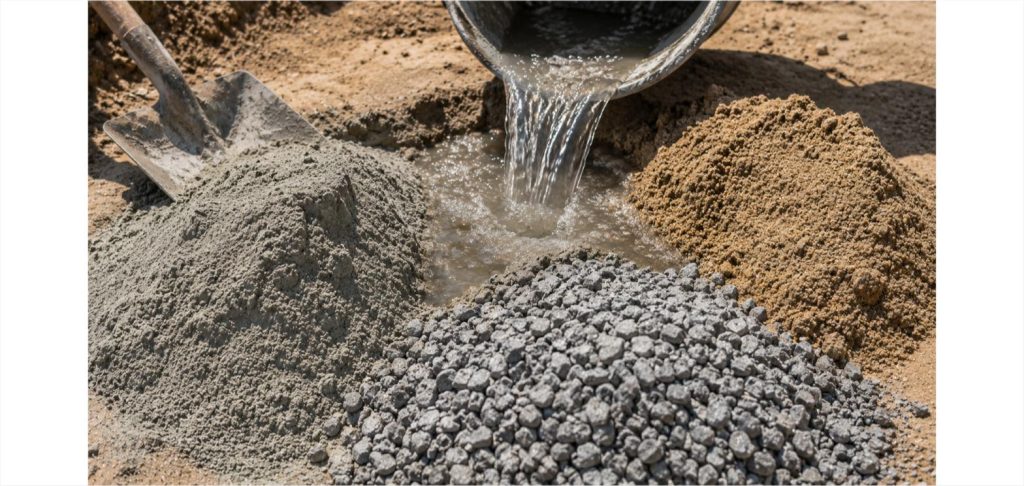
Concrete is a mixture of Portland cement, aggregate (sand and gravel or crushed stone), and water, which hardens through a chemical reaction called hydration rather than by drying out. Strength is measured in PSI, mix ratios describe the proportion of cement to aggregate, and proper curing over roughly 28 days is what allows concrete to reach its full design strength.
Concrete = Cement + Aggregate + Water + (Optional Admixtures & Reinforcement)
What Is Concrete, Exactly?
Concrete is a composite building material made from three core ingredients: Portland cement, aggregate, and water. When mixed together, cement and water undergo a chemical reaction called hydration, which binds the aggregate into a solid, rock-like mass. This is an important distinction from common assumptions — concrete doesn’t harden because it dries out, it hardens because of an ongoing chemical reaction, which is why keeping concrete moist during curing actually helps it get stronger, not weaker. The word ‘cement’ is often used interchangeably with ‘concrete’ in casual conversation, but cement is really just one ingredient — the fine gray powder that reacts with water to bind everything else together.
Portland Cement: The Binding Ingredient
Portland cement is manufactured by heating limestone and clay (or similar materials) in a kiln at extremely high temperatures, then grinding the resulting material into a fine powder. It’s classified into different types depending on application — general purpose (Type I), moderate sulfate resistance (Type II), high early strength (Type III), and others suited to specific climates or soil conditions. For most residential DIY projects, a general-purpose bagged concrete mix already contains an appropriate cement type, so you don’t usually need to select cement separately unless you’re batching concrete completely from scratch.
Aggregate: Sand, Gravel, and Crushed Stone
Aggregate makes up the bulk of concrete’s volume — typically 60 to 75 percent — and is divided into fine aggregate (sand) and coarse aggregate (gravel or crushed stone). Aggregate isn’t just filler; its size, shape, and gradation significantly affect the finished concrete’s strength, workability, and surface finish. Well-graded aggregate, meaning a good mix of particle sizes from fine to coarse, packs together efficiently and requires less cement paste to fill the gaps, which generally produces stronger, more economical concrete. Bagged pre-mixed concrete already includes properly graded aggregate, which is one of the main reasons it produces consistent results for DIY users.
The Water-Cement Ratio
The ratio of water to cement in a mix is one of the single biggest factors determining concrete’s final strength. A lower water-cement ratio generally produces stronger, more durable concrete, but also makes the mix stiffer and harder to work with, while adding more water makes concrete easier to pour and finish but significantly weakens the cured result. This is why following the exact water amount specified on a bag of pre-mixed concrete matters so much — it’s tempting to add extra water to make mixing easier, but doing so can meaningfully reduce the strength of the finished slab, footing, or post. Professional mix designs balance workability and strength carefully, often using admixtures rather than extra water to improve workability without sacrificing strength.
Understanding PSI and Mix Strength
Concrete strength is measured in PSI (pounds per square inch), representing how much compressive force a fully cured sample can withstand before failing. Common residential PSI ratings range from 2,500 PSI for very light-duty applications up to 4,000 PSI or higher for driveways, structural footings, and cold-climate applications exposed to freeze-thaw cycling. Higher PSI isn’t automatically ‘better’ for every application — it’s about matching the mix to the load and environmental exposure the concrete will face. A patio doesn’t need the same PSI as a foundation footing supporting a structure, and ordering unnecessarily high-strength concrete simply adds cost without a meaningful benefit for light-duty uses.
Mix Ratios Explained
You may see concrete mix ratios described as a set of numbers, such as 1:2:3, representing the relative proportions of cement, sand, and gravel by volume. A 1:2:3 ratio, for example, means one part cement to two parts sand to three parts coarse aggregate, which produces a general-purpose mix suitable for many residential applications. These ratios are a useful mental model for understanding how concrete is proportioned, though most DIY users will use pre-proportioned bagged concrete rather than batching individual mix ratios themselves, since bagged mixes already incorporate a tested, appropriate ratio for general use.
Admixtures: Modifying Concrete’s Behavior
Admixtures are additional ingredients mixed into concrete to change its properties without changing the base cement-aggregate-water formula. Air-entraining admixtures introduce microscopic air bubbles that help concrete resist damage from freeze-thaw cycling, which is especially important for driveways, steps, and curb and gutter work in cold climates. Water-reducing admixtures (plasticizers) improve workability without adding extra water, helping maintain strength while making the mix easier to place and finish. Accelerating admixtures speed up curing time, useful in cold weather or when a fast turnaround is needed, while retarding admixtures slow curing down, useful in hot weather or for large pours that need extra working time.
Reinforcement: Rebar, Wire Mesh, and Fiber
Because plain concrete is strong in compression but weak in tension, reinforcement is used to help it resist cracking and bending forces. Rebar (reinforcing steel bar) is sized by number, where each number roughly corresponds to the bar’s diameter in eighths of an inch — a #4 bar is about half an inch in diameter, for example. Welded wire mesh is a grid of thinner wire welded at intersections, commonly used in slabs and patios where loads are lighter than a driveway or footing. Fiber reinforcement, synthetic fibers mixed directly into the concrete, helps control shrinkage cracking throughout the entire pour rather than at discrete locations, and is often used alongside, not instead of, traditional rebar or mesh on larger projects.
The Curing Process
Curing is the period during which concrete gains strength through ongoing hydration, and it’s arguably as important as the mix design itself. Concrete reaches roughly 70 percent of its design strength within the first 7 days, but the full 28-day curing period is the standard benchmark used to rate a mix’s official design strength. Keeping concrete moist during the first several days — through wet burlap, plastic sheeting, or a curing compound — helps it cure evenly and reach its full potential strength, especially in hot or windy conditions where surface moisture can evaporate too quickly.
Ready-Mix vs Bagged Concrete
Ready-mix concrete is batched at a plant and delivered by truck, offering consistent quality and efficiency for larger pours, generally anything over about one cubic yard. Bagged concrete is pre-proportioned and mixed on-site with water, making it practical for smaller jobs like fence posts, small repairs, or projects where a full truck delivery isn’t cost-effective. Both approaches use the same underlying principles of cement, aggregate, water, and curing — the choice mainly comes down to project size, budget, and how much hands-on mixing labor you’re prepared to do.
Weather and Temperature Considerations
Concrete’s hydration reaction is sensitive to temperature. Pouring in very hot weather can cause the surface to dry out and crack before it has a chance to properly cure, while pouring in freezing temperatures can stop hydration altogether and potentially damage the concrete permanently if it freezes before reaching sufficient strength. Many suppliers offer cold-weather or hot-weather mix adjustments, and it’s worth discussing your pour date and expected temperatures with your local ready-mix supplier if you’re working outside of mild, moderate conditions.
Putting It All Together
Every concrete project, whether it’s a small fence post footing or a full driveway, follows the same underlying principles: choose an appropriate PSI and mix design for the application, calculate the volume you need accurately (including a waste factor), reinforce appropriately for the load, place and finish the concrete before it begins to set, and cure it properly for the first several days to weeks. The individual calculators on this site handle the volume and material math for each project type, but understanding these fundamentals helps you make better decisions about mix strength, reinforcement, and timing along the way.
Explore the Calculators
Ready to calculate your project? Use the Slab Calculator for patios and driveways, the Footing Calculator for wall and post footings, the Column Calculator for sonotube and post pours, the Circular Slab Calculator for round pads, the Steps Calculator for stairways, the Curb & Gutter Calculator for curb runs, the Concrete Bags Calculator to convert volume into bag counts, or the Concrete Cost Calculator to estimate material cost.
Mix Ratios & Strength Grades
- Cement, Sand & Aggregate Ratio Guide by Concrete Strength
- Aggregate Size Guide: 8mm, 16mm & 20mm Bajri Explained
- How to Calculate Concrete Mix Ratio & Material Quantities
- Concrete Grade & PSI Strength Guide
Material Quality & Testing
- Material Grading in Concrete: Aggregate & Sand Grading Explained
- Concrete Material Testing: An Overview of Quality Control
- How Cement Is Tested: Standard Cement Quality Tests Explained
- Sand Testing for Concrete: Methods, Standards & Why It Matters
- Cylinder vs Cube Strength Testing Explained
- Concrete Slump Test: What It Is and Why It’s Done
- Concrete Setting Time: Initial Set, Final Set & What’s Normal
- Why Temperature Control Matters Before Pouring Concrete
- Silica in Concrete: The Role of Silica Fume & Pozzolanic Materials