Cement, Sand & Aggregate Ratio Guide by Concrete Strength
The right cement-sand-aggregate ratio is the single biggest factor separating a 3000 PSI slab from a 6000 PSI structural pour. This guide breaks down proven mix ratios by strength grade, explains why they change, and shows you how to apply them on site.
Why the Mix Ratio Changes With Strength
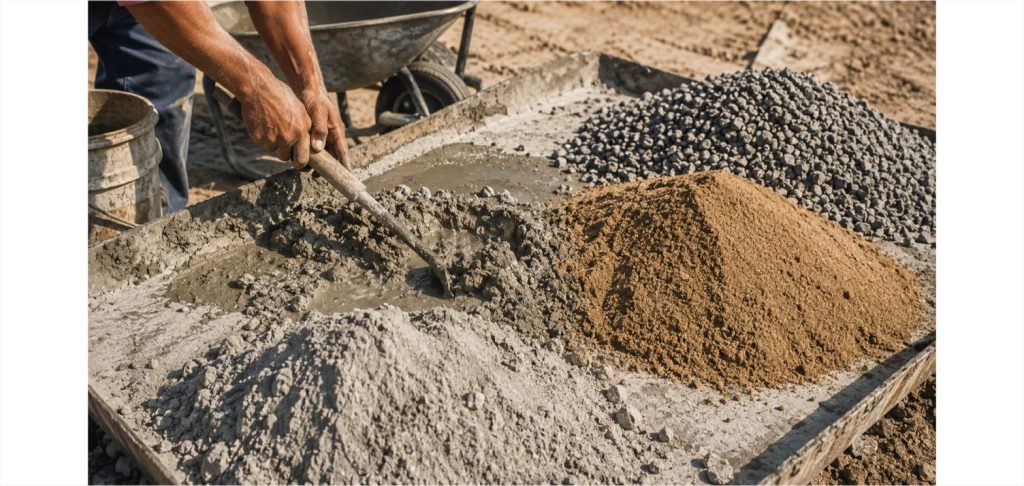
Every concrete mix is built from the same three core ingredients — cement, sand (fine aggregate), and bajri or crushed stone (coarse aggregate) — combined with water. What changes from one job to the next is the proportion of these materials. Cement is the binder that gives concrete its strength, so as the proportion of cement in the mix increases relative to sand and aggregate, the potential compressive strength rises as well. A lean 1:3:6 mix might be perfectly fine under a garden path, but the same ratio would fail under a loaded structural column rated for 5000 PSI.
Strength is usually specified in PSI (pounds per square inch) in the US and parts of South Asia, or in MPa/grade (M15, M20, M25…) elsewhere. Regardless of the labeling system, the underlying logic is identical: more cement and less water relative to aggregate generally means higher strength, up to the point where the mix becomes difficult to place and finish.
Reading a Mix Ratio Like 1:2:4
A ratio written as 1:2:4 means, by volume: 1 part cement, 2 parts sand, 4 parts coarse aggregate. These numbers are relative — you can use any container (a bucket, a wheelbarrow load, a bag) as your “1 part” as long as you stay consistent across all three materials. The total of the ratio (1+2+4 = 7) is used later to split up the total dry volume of concrete you need.
- Richer mixes (more cement per part, such as 1:1.5:3) are used where higher strength or better durability is required.
- Leaner mixes (less cement per part, such as 1:4:8) are used for non-structural fill, blinding layers, or backfill under footings.
- Standard structural mixes for most residential slabs, footings, and driveways fall between 1:1.5:3 and 1:2.5:5.
Quick Reference Table: Ratio by PSI Grade
| Target Strength | Approx. Ratio (Cement:Sand:Aggregate) | Typical W/C Ratio | Common Use |
|---|---|---|---|
| 2000–2500 PSI | 1:3:6 | 0.60–0.65 | Blinding, mass fill, non-structural backfill |
| 3000 PSI | 1:2.5:5 | 0.55–0.60 | Sidewalks, patios, light residential slabs |
| 3500–4000 PSI | 1:2:4 | 0.50–0.55 | Driveways, exterior flatwork, standard footings |
| 5000 PSI | 1:1.5:3 | 0.45–0.50 | Garage floors, structural footings, load-bearing slabs |
| 6000 PSI | 1:1:2 | 0.40–0.45 | Columns, high-load structural elements, industrial floors |
These ratios are general starting points, not laboratory mix designs. Actual proportions shift depending on cement type, aggregate grading, and admixtures — always confirm with a local supplier or engineer for structural work.
3000 PSI Concrete Mix
A 3000 PSI mix is the workhorse of residential concrete. It’s strong enough for sidewalks, patios, and interior slabs-on-grade that don’t carry heavy structural loads, yet lean enough to keep material costs reasonable. A 1:2.5:5 ratio with a water-cement ratio around 0.55–0.60 is a common starting point. This grade is rarely used for anything that will see vehicle traffic or freeze-thaw cycling without added durability measures.
4000 PSI Concrete Mix
Stepping up to 4000 PSI is the standard choice for driveways, exterior flatwork, and most footings in residential construction. The tighter 1:2:4 ratio and lower water content improve both strength and resistance to weathering, abrasion, and de-icing salts where applicable. Many local codes specify 4000 PSI as the minimum for exterior slabs exposed to freeze-thaw conditions.
5000 PSI Concrete Mix
At 5000 PSI, concrete moves into structural territory — garage floors expected to carry vehicle loads, footings under load-bearing walls, and slabs subject to heavier point loads. A 1:1.5:3 ratio with a water-cement ratio near 0.45–0.50 is typical. Placing and finishing this mix is less forgiving; it sets faster and needs more attention to curing to avoid surface cracking.
6000 PSI Concrete Mix
6000 PSI and above is reserved for columns, industrial floors, and structural elements carrying significant loads. The ratio tightens further to roughly 1:1:2, often paired with lower water-cement ratios and sometimes admixtures such as superplasticizers to keep the stiff mix workable enough to place without adding extra water on site. Skipping the admixture and simply adding water to loosen a 6000 PSI mix is one of the fastest ways to lose the strength you paid for.
What About 200 PSI Concrete?
Very low strength mixes around 200–1500 PSI are sometimes specified for blinding concrete (a thin leveling layer poured before footings), void fill, or as a cushion under paving. These lean mixes, often 1:4:8 or leaner, use minimal cement and are not meant to carry structural load — they exist purely to provide a stable, level working surface.
How the Water-Cement Ratio Changes Everything
Water-Cement Ratio (w/c) = Weight of Water ÷ Weight of CementTwo mixes can use the identical 1:2:4 cement-sand-aggregate ratio and still produce very different strengths purely based on how much water is added. Extra water makes concrete easier to pour and finish, but it also increases the pore space left behind once the water evaporates, weakening the hardened material. As a rule of thumb, keeping the water-cement ratio between 0.40 and 0.55 for structural mixes protects the strength you’re paying for in cement.
How Aggregate Size Interacts With the Ratio
The same cement-sand-aggregate ratio can behave differently depending on whether you’re using 8mm, 16mm, or 20mm aggregate. Smaller aggregate needs more cement paste to coat its larger combined surface area, while larger aggregate is more efficient in bulk fill but harder to compact into thin sections. We cover this relationship in detail in our aggregate size guide.
Worked Example: Calculating a 4000 PSI Mix for a Small Slab
Say you need 1 cubic meter of finished 4000 PSI concrete using a 1:2:4 ratio.
Dry Volume = Wet Volume × 1.54 = 1 m³ × 1.54 = 1.54 m³The 1.54 factor accounts for the volume lost as sand and aggregate settle into the voids between particles once mixed and compacted.
Cement Volume = (1 ÷ 7) × 1.54 = 0.22 m³ → ≈ 6.35 bags of cement (50kg)
Sand Volume = (2 ÷ 7) × 1.54 = 0.44 m³
Aggregate Volume = (4 ÷ 7) × 1.54 = 0.88 m³
Add 5–10% extra to each figure to cover on-site wastage, spillage, and compaction losses. For a full breakdown with your own dimensions, use our Concrete Bags Calculator or Concrete Cost Calculator.
Common Mistakes When Choosing a Ratio
- Using a lean mix ratio meant for fill under a structural slab or footing.
- Adding extra water on site to make a stiff, high-strength mix easier to pour — this quietly destroys the strength grade.
- Ignoring aggregate size when scaling a ratio from a small test batch to a full pour.
- Assuming ratios are universal — cement type, humidity, and local aggregate quality all shift the ideal proportions slightly.
- Not accounting for wastage, resulting in running short of material mid-pour.
Related Reading
- Aggregate Size Guide: 8mm, 16mm & 20mm Bajri Explained
- How to Calculate Concrete Mix Ratio & Material Quantities
- Concrete Grade & PSI Strength Guide
- Concrete Bags Calculator
Frequently Asked Questions
What is the strongest common cement-sand-aggregate ratio?
A 1:1:2 ratio is among the richest commonly used, targeting roughly 6000 PSI or higher for heavily loaded structural elements like columns.
Can I use the same ratio for every part of a house?
No. Footings, slabs, and columns often carry different loads and are typically specified at different PSI grades, so the ratio should be matched to each element’s requirement.
Does more cement always mean stronger concrete?
Only up to a point, and only if the water-cement ratio is controlled. Adding cement without controlling water, or without adequate curing, does not guarantee proportional strength gains.
What ratio is used for a normal house slab?
Most residential slabs-on-grade use a 3000–4000 PSI mix, roughly a 1:2:4 to 1:2.5:5 ratio.
How much does aggregate size affect the ratio?
Finer aggregate generally needs slightly more cement paste to fill voids, while larger aggregate can reduce paste demand — see our aggregate size guide for details.
Should I trust a fixed ratio for structural work?
For any load-bearing structural element, confirm your mix design with a local engineer or ready-mix supplier rather than relying solely on general ratios.